

Half of all employees never negotiate their pay after they join a role.
The other half usually asks too late, in the wrong conversation, with language that telegraphs they don't believe their own number. They wait for the formal review, even though the decision was made months ago. They round their numbers. They hedge with "around" and "approximately." They stop talking when they should be asking the next question.
The cost gets worse. A salary you don't fight for becomes the baseline for every raise after that. A budget you accept without pushback becomes the budget you have next year. The conversation that didn't happen this cycle is the ceiling on what's possible next cycle.
Most of this is fixable with a handful of moves that take minutes to learn and years to actually use.
Above is the recent webinar with Darren Smith from Making Business Matter, walking through how to ask for more money without winging it. Below are my takeaways on the principles that matter most for L&D pros, applied to both your own comp conversations and the budget meetings you keep losing.
TL;DR
- The pay decision is usually locked in before you have the conversation. The same goes for the L&D budget.
- Reliable execution is the trap. The people who keep things running without complaining are the ones who fall behind.
- Activity metrics like training hours and completion rates are the L&D version of "I'm a hard worker."
- The open question that flips negotiations. Ask what you'd need to do to achieve a specific number by a specific date.
- Round numbers and hedge words like "around" telegraph that you don't believe your own ask.
- L&D pros have more variables to negotiate with than almost any other function.
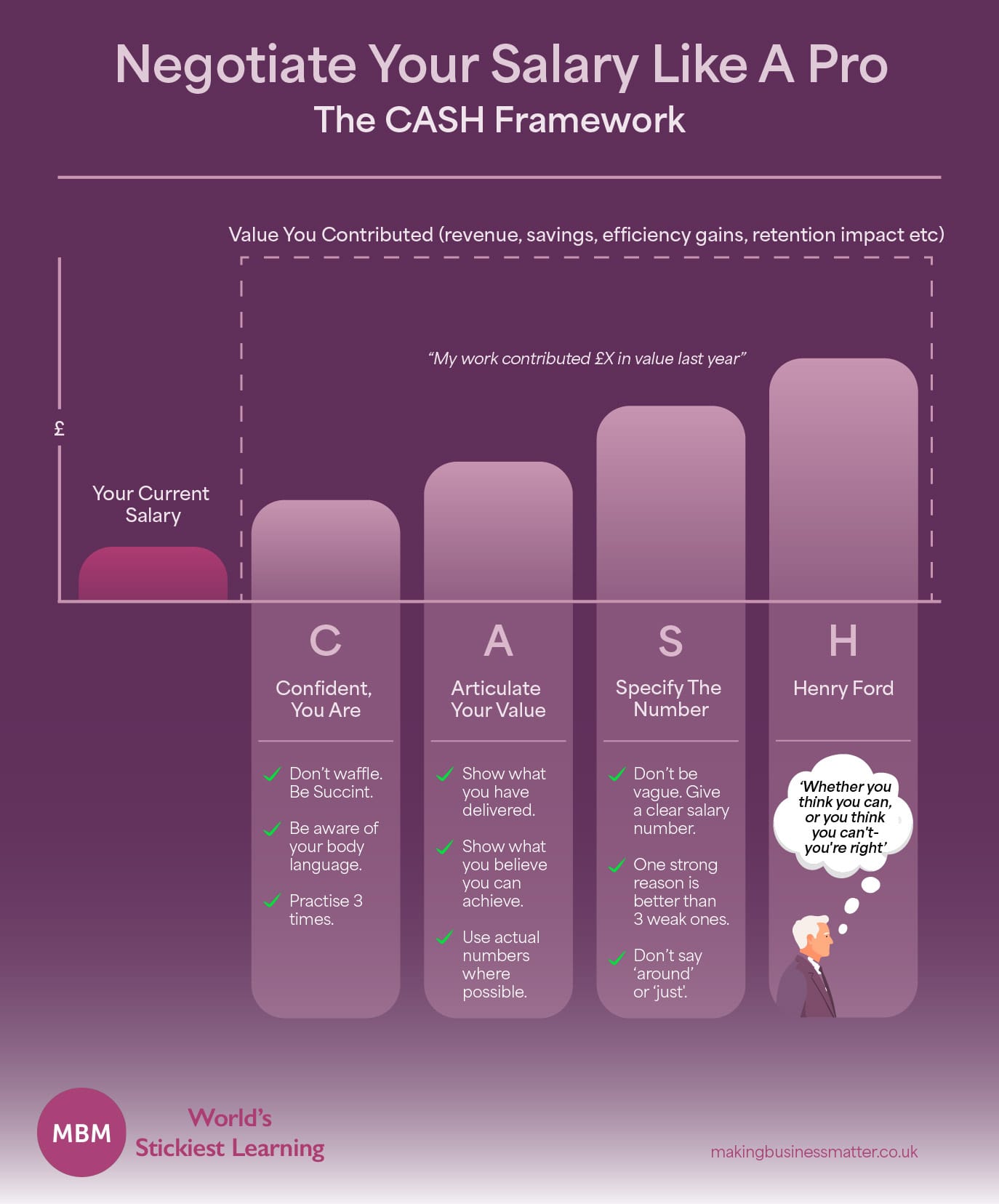
- Use the CASH framework to build confidence, articulate your value, specify the number, and adopt the right mindset (see screenshot below).
1. Your salary was decided months before the review conversation
Darren opened with a quiz, and one question landed harder than the others. When a pay rise gets refused, what's the most common reason?
The answer wasn't that your manager doesn't value you. It wasn't that the role isn't important enough. The most common reason is that pay decisions get locked in before the formal review conversation ever starts.
By the time you're sitting across from your manager in February or March asking for more, the budget for that fiscal year has been set, allocations have been distributed across teams, and your number is already in a spreadsheet somewhere.
This is L&D's pattern too, and it operates on a longer cycle.
L&D budgets get drafted in Q3 of the prior fiscal year. Headcount plans for next year get debated in Q4. By the time you're walking your boss through your training proposal in January, the question of how much money exists for L&D was answered three months ago by someone who probably wasn't in the room.
The most important negotiation conversations in L&D happen six to nine months before anyone calls them negotiations. They look like hallway conversations with the CFO about which programs are working. They look like Slack messages to your business partners asking what skill gaps are showing up in their teams. They look like an email to your boss in August about the data you'll need to make the case in October.
Most L&D pros wait until the formal budget meeting to make their case. By then, the answer is already written.
How to shift your timing:
- Map your organization's planning cycle by asking your finance partner when budget conversations actually start, when allocations get drafted, and when the windows close. The formal calendar is a downstream artifact of decisions made earlier.
- Build your evidence file in the months before by tracking program outcomes, business impact, skill gap data, and testimonials from leaders. Show up to the early conversation with proof, not promises.
- Have the pre-conversation with your boss six months before the review by saying something like "I want to make sure we're set up for a strong comp conversation in March. What would I need to demonstrate between now and then?"
- Find the actual decision-makers by asking your boss who else weighs in on comp or budget decisions, then build relationships with those people now rather than meeting them for the first time when you're asking for something.
2. Reliable execution can be a trap that keeps L&D pros underpaid
The same quiz had another question worth pausing on. Who's most likely to drift below market pay over time?
Not new starters. Not average performers. Reliable high performers.
